
Ji Ben Gong
Qi Gong is present in the warm-up, with exercises that prepare the body by encouraging coordination, flexibility and relaxation, and fluidity of breathing. With a very Chinese notion of working through repetition of movement: weight transfers, pelvic rotations and arm movements already have a clearly martial vocation.
Seemingly minimalist, these complex movements, executed with millimetre precision, can be adapted to a thousand martial applications, from defensive parrying to projections and arm locks. Every part of the body is called upon and can be used as a weapon. A nod to our rugby friends, with frequent shoulder strikes for close combat!
The Chinese practise tai chi chuan on a daily basis not so much out of martial interest as to maintain the body and preserve health. Nevertheless, only by understanding the martial purpose of the movements can they be performed correctly. Deprived of meaning, gestures are distorted, affecting joint work and the free circulation of breath. We can no longer speak of energy work: we’re just doing gymnastics.
Tao Lu
Tao Lu are the karate equivalent of katas: a series of moving movements, or “boxing the shadow”, that take the form of boxing against an imaginary opponent.
Lao Jia is the first sequence or Yi Lu: 75 series of movements that must be performed smoothly and fluidly to acquire the fundamentals of the Chen style. Low postures are used to strengthen the muscles, progressive transfers of support create a real game of balance, and extreme relaxation links each movement to the next until the final posture is reached. These supple, circular movements constitute parries and disengagements, punches and kicks, executed at the four cardinal points.
Of course, learning this complex sequence takes time and dedication. Short forms were therefore developed by the Chen masters.
The second sequence is called Er Lu (Pao Chui) and consists of a succession of explosive movements, including the famous “gun punch”. Once the basic principles have been acquired, this sequence is said to allow the expression of energy. The master believes that the martial aspect should be developed as the student’s physical capacities are strengthened. As proof of this, with a flick of the wrist, he sends flying the student who is too eager to fight. Master Chen, sitting low on his legs, unshakeable, expresses a power that makes the energetic dimension of tai chi chuan palpable.
The weapons
Once you’ve mastered the bare-hand sequence, you’ll learn to use the sword, saber, spear and halberd, in ascending order of difficulty.
Tui Shou (sticky hands)
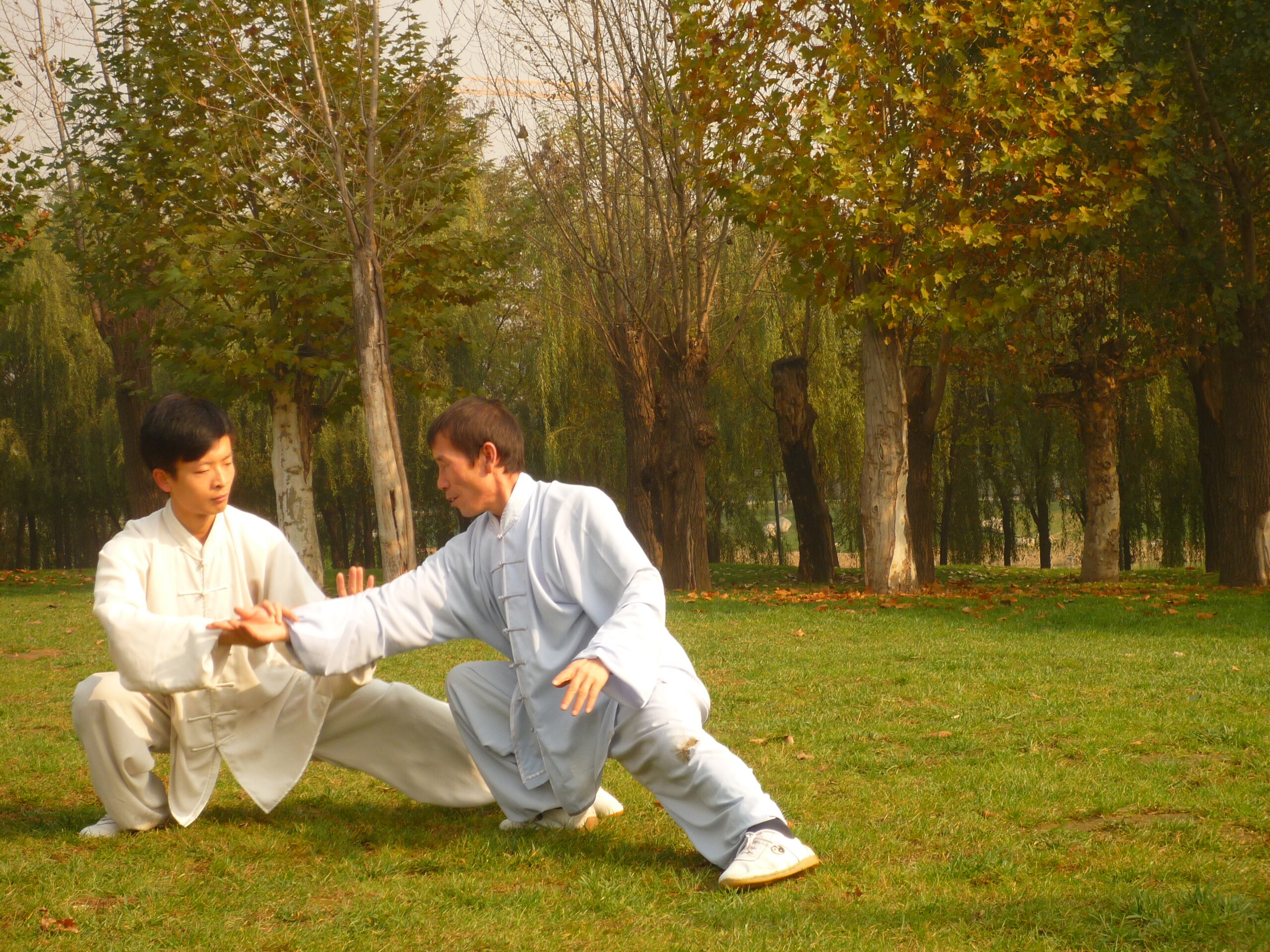
This is a two-person exercise involving contact between the opponents’ hands and elbows. They move while trying to maintain contact, the aim being to be relaxed and attentive to each other. So, in the middle of a routine of movements, when one of them loses vigilance or posture, the other takes the opportunity to unbalance and attack his opponent with lightning speed, usually resulting in a projection or a joint lock. The tui shou technique consists in absorbing and deflecting the opponent’s force, then turning it against him.
In China, students are gradually introduced to the subtle art of tui shou, which gives rise to competitions in a form of Chinese wrestling.
Sanshou
Sanshou, or combat training, is the final stage in this apprenticeship, which emphasizes energy work and respect for others.
Nevertheless, as most students come to taichi for its “health and well-being” aspect, few schools, even in China, transmit the truly combative dimension of tai chi chuan.
Practice levels
Of course, as with other sports, there are different levels of physical commitment: tai chi chuan can be practised up to an advanced age, with gentle movements that respect physical integrity. Rather than forcing, it’s better to work on muscle relaxation.
However, the athlete who embraces tai chi chuan intensively may experience a state of overcoming muscular pain similar to that experienced by joggers beyond a certain running time, when pain disappears to be replaced by a sense of well-being.
Others prefer to work more flexibly, but in the end, training depends on the physical condition, age, commitment and expectations of each practitioner. The master adapts.
Recommended for the elderly because it can be practised gently, genuine taichi is not just a maintenance exercise for the elderly. The long and subtle process of learning tai chi chuan enables you to feel good in body and mind, and to maintain your composure without letting yourself be pushed around. Like a boxing match that hides a fist in a velvet glove!
So here’s a little overview of Chen school tai chi chuan, which I hope has enlightened you and inspired you to give it a try yourself!