
How do you pass the bar without tiring yourself out or getting in the way of other surfers?
Observation
Before jumping into the water, the surfer must observe the environment: beach topography, terrain features, meteorological factors, surfers in the water also provide certain clues.
To avoid: I'm going into the water in front of the peak, instead of going around the waves. Not only will I have trouble getting over the bar because I'm going where there are the most waves to get over, but I'll also end up in front of the take-off zone and trajectory of the other surfers, who I'll hinder in their progress on the wave.
Identifying currents
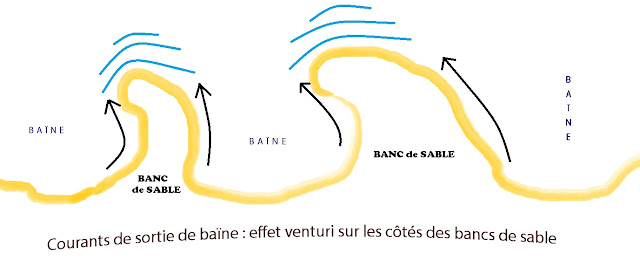
In the Landes region, waves break on a sandbar framed by baïnes, deeper areas that don't allow waves to form (except in rough sea conditions, when the horizon is barred by long swell lines). On the sides of the sandbar, at the edge of these bays, "juice spots" can be identified, with foam and eddies forming a river current that will carry the surfer out to sea, bypassing the wave zone. Bayes are the coral reef's equivalent of a lagoon: through a narrow passage, the lagoon empties, allowing the surfer to reach the open sea.
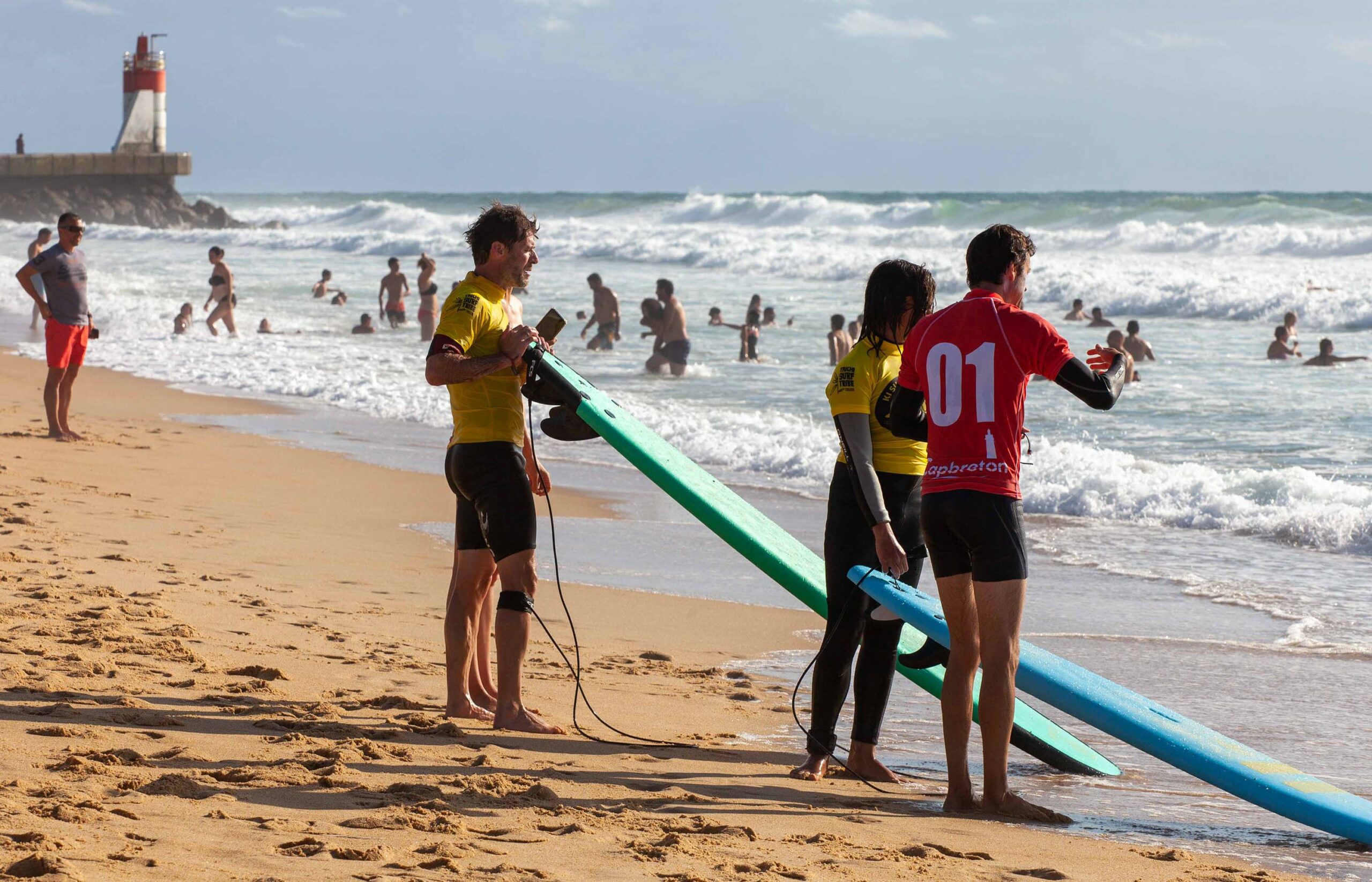
At Capbreton, where there are rocky breakwaters, the same Venturi Effect seen at the edge of sandbanks creates an outgoing current along these rocky spurs, dragging the surfer to the bottom while attenuating the power of the waves at this precise point. The same phenomenon can often be observed at the edge of a cliff when surfing in a bay, for example.
Likewise, observing other surfers can help you gauge the current: surfers drift quickly to the left, so it's in my interest to get around the sandbar far to the right to avoid being knocked down before I can reach the open sea.
In the Landes region, the baïne currents generally connect in a north-south lateral current, so reaching the northern peak from the southern baïne will often prove exhausting, as you'll have to climb back up against the current. By going north, the current naturally leads the surfer towards the wave zone, without the need for force.
Identify human and natural obstacles
On Capbreton's main beaches, the bays are not very pronounced, and the beach forms an almost rectilinear sandbank, parallel to the coastline. Waves break close to the shore, so it's physically possible to enter the water anywhere, except in rough conditions. However, if a group of surfers is waiting offshore at a particular point, it's a good idea to go around them and into a surf-free lane, to avoid disturbing them and for your own safety.
Of course, a subtle dip in the sandbank, a hint of juice stains or a dyke provide clues to facilitate passage. Human gatherings are one danger, rocky groynes, cliffs, surface rocks and blockhouses another: you need to observe the strength and direction of the current to avoid being drawn into one of these obstacles.
The five golden rules
Based on observation of the above parameters, define a water entry strategy, taking into account a few rules:
I never fight the current, I use it: to pass the bar, to gain the peak, to preserve my safety. For example, if the current pushes me towards a rocky spur, which is close by and I'm at the end of my rope, I let the current carry me past the obstacle and get out of the water on the next beach.
I'm not panicking: how many surfers climb those same wave-beaten rocky spurs, panicked and exhausted, when all they would have had to do was let the current take them beyond the danger zone.
I assess the risks in relation to my technical level and physical condition: as with any outdoor sport, there comes a time when the surfer must bow to the element. When wind, waves and currents are stronger than usual, it's wise to question your abilities before jumping in. There may be less hostile spots to fall back on.
I anticipate the risks and constraints: if I'm surfing in a bay and the coast is then blocked by impassable cliffs, I can't allow myself to be swept away by the current because I won't find any shelter to get out of the water. So I start paddling towards the beach well before I reach the critical point, in order to anticipate the lateral drift. Surfers don't always think about getting out of the water when they're tired.
To save time and energy, I ask for advice from those who know - surfers, professionals, surf schools.
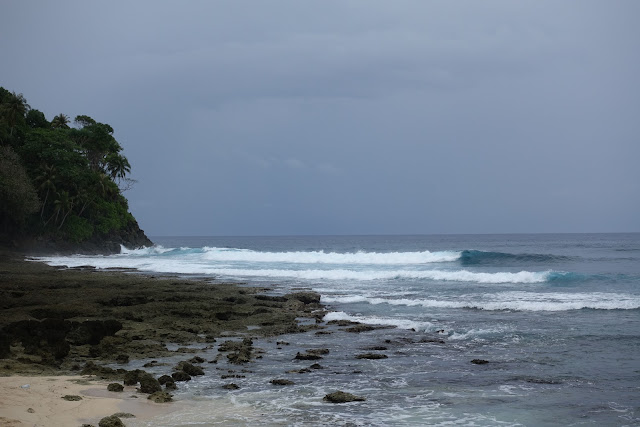
Water inlet and outlet
In calm weather or under a green flag, currents and shore breaks are kept to a minimum. On the other hand, when the sea is rough, the shore area can become a risk zone.
The baïne, an ideal place to take the helm as the bottom falls away steeply, also offers a few constraints: after the first few metres, the surfer encounters no more waves. What's more, especially in rough seas, an edge wave breaks directly on the sand. It's all about getting in and out of the water at the right moment, between two sets of waves.
In the baïnes, the steepest part of the beach, swimming is often dangerous, as the waves hit the bather one after the other, preventing him or her from getting back onto the beach, and the surfer who gets in at the wrong time can't duck under the waves, because of their power in an area where the water recedes almost completely. The risk here is that the board, moving back and forth to the rhythm of the waves, will come back on him, carried by the wave-current alternation.
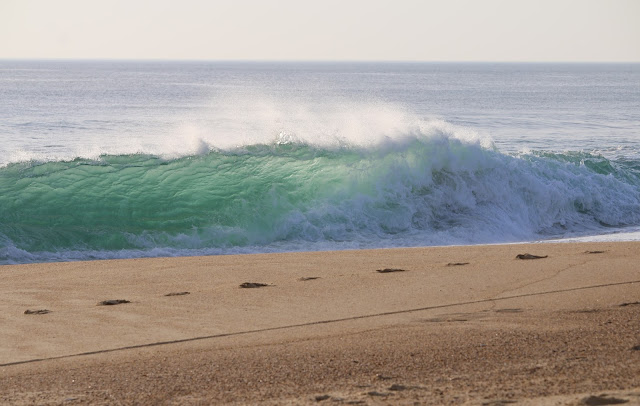
This is not the case for the sandbank, which slopes gently out to sea, so that waves roll from the bottom to the shore, losing their power and landing on the sand in the form of foam. However, at high tide, the sandbank can also experience a shore-break wave that breaks forcefully on the sand.
Exit from the water must therefore also be anticipated: the current and the evolution of the tide mean that the surfer won't always exit at the ideal spot. If he lands in a shore break zone, he'll have to wait a meter from the shore for the calmest moment to get out of the water. One technique is to row in the wake of the wave with a delay, so as to be deposited by the ripple on the sandbank. It's advisable to try this technique first without the board, in light conditions, as it requires a minimum of aquatic ease.
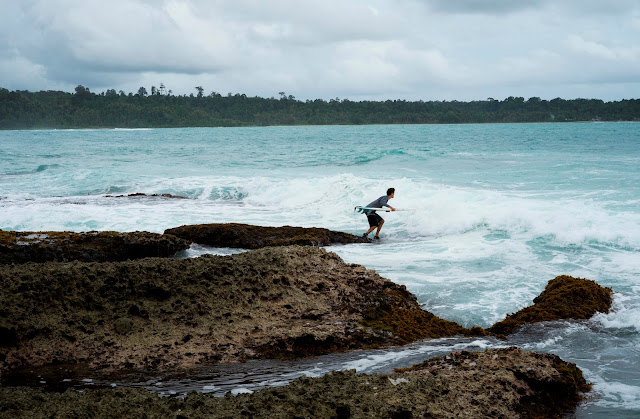
When the beach is made up of rocks, the water's entry and exit zones are often limited, and the timing must be perfect, otherwise you'll end up on the rocks.
Back to the peak
The wave catch naturally carries the surfer towards the edge as well as to the sides of the sandbar. In light conditions, a good surfer can duck and pass the bar anywhere without much difficulty. So, having just caught a wave, he'll sometimes be tempted to take the shortest route back to the peak.
By doing so, he may get back to the peak in record time, but at the same time he'll be in the way of surfers on the waves, as he'll be right on the breaker line.
To avoid becoming a liability, but also to avoid being hit, it's advisable, if possible, to avoid the surf zone, both when launching and during the session.