
The Labrador complex is a psychic pathology that affects many surfers.
Mild forms of the disease are of no consequence. However, in severely affected individuals, the symptoms triggered can be extremely dangerous, both for the patient and for able-bodied surfers in the vicinity.
This condition is known as the Labrador complex, because it manifests itself as "mad dog" behavior. As we all know, Labradors love water, hence the analogy with surfers. Let's decipher the behavioral manifestations of this disease, which is difficult to treat if not detected early enough:
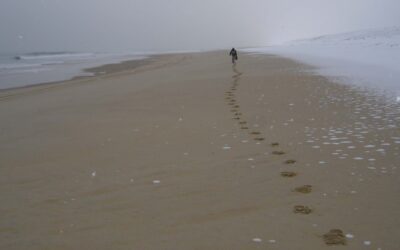
1. The surfer is running down the dune, his body language not a good sign for the surfers already in position at the line-up.
2. The surfer is at point A, on the beach, the waves are at point B, offshore. As soon as he has visually caught his target, the surfer forgets everything that exists between point A and point B.
Common sense would dictate that he should analyze the position of the sandbar and the bay, the current, the surfers and the breaking line, but he'll cut as short as possible, instead of skirting the waves, by cutting straight across. If the waves are a bit strong, he'll have a hard time getting offshore, because he'll be facing the waves instead of going around them. There's also a risk of getting in the way of surfers at the peak, because by coming up against the surf zone, he's putting himself in the path of surfers riding the waves. It moves up the surf line, which is dangerous.
3. You're alone in the water, there's no defined peak, the waves break anywhere, facing one of those Landes beaches that stretch as far as the eye can see. The Labrador has hooked his target, rowing straight at you, almost sitting on your lap, fighting you for priority, taxing you in the worst case.
To get rid of this invasive friend, you're going to have to be firm, but not mean. He doesn't know what he's doing, and may even think you're a dolphin.
4. Affected surfers will display "ball-seeking" behavior. As soon as a ripple approaches, he or she rushes towards it, agitated by spasms; like his or her canine alter-ego, he or she runs right to left, until he or she loses breath, as if disoriented. Other surfers, seated calmly, are often stunned by such frenzy.
Depending on the level of the sick surfer, the consequences will not be the same: low-level surfers will fail to start on most waves, as the excitement affects their sense of observation. Advanced surfers, on the other hand, will want to catch as many balls as possible - by which I obviously mean waves - and will thus forget the elementary sense of sharing to the point of seriously irritating healthy surfers.
5. The surfer can live with this disease until an advanced age, in the absence of screening. And if his behavior proves annoying to those around him, the Labrador complex rarely leads to aggressive behavior. There are cases, however: the heavily affected surfer will urinate on the beach to mark his territory, want to defend his patch, sniff out newcomers, growl and sometimes pretend to chase them off the spot. He may even bite other surfers in the area, because the disease impairs his ability to judge, like an old dog with cataracts.
If you think you suffer from this disease, talk to your doctor. There are some very good herbal treatments available. Cure is rarely achieved, but it is possible to limit the severity of symptoms.