
Charter for the preservation of wild waves
“Wild Wave Preservation Charter” is the title I had in mind at first, but it’s less catchy!
Let’s be honest, I’ve only just invented this charter, but that’s how all the ideas and beginnings of concerted thinking start.
The disappearance of preserved coastal areas
There are hardly any natural coastal areas left in the world , untouched by concreting, mass tourism and a form of seaside standardization that includes the development of surf tourism. The rare areas off the radar are disappearing.
A charter against limitless business
This charter aims to preserve these areas by stopping the development of a business with no limits and no conscience, starting with the surf school business, of which I’m a part.
Surf schools and surf culture
Surf schools represent not only a sport but also, in my opinion, a culture. In this culture, the massification of groups of surfers, the invasion of confidential surfing areas (the famous “secret spot”) and the despoiling of natural spaces are the opposite of the “spirit of surfing”.
The Capbreton – Hossegor – Seignosse case
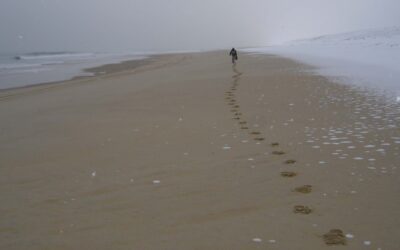
To take the example of the Capbreton-Hossegor-Seignosse surfing region, there is a wide variety of signposted surf beaches, from south to north – let’s say around fifteen – offering a vast playground for surfers, surf schools and their trainees. In this part of the south of the Landes region, there are a few rare areas off the beaten track, inaccessible by car, which can be described as confidential zones and which, until recently, escaped motor vehicles and the surfing business.
An unwritten rule now under threat
It was an unspoken rule among surf schools in the area, with the exception of certain surfcamp facilities which I won’t mention, that they were forbidden from holding classes on these natural beaches, thus allowing free surfers to find an unspoilt spot, since in summer, surf schools take up a large part of the space dedicated to surfing on all the other beaches.
A personal choice
There’s an embarrassment of riches to choose from when it comes to finding a spot in Capbreton, Hossegor or Seignosse. Personally, I’ ve chosen not to overuse the term “secret spot”, to run my surf school in a way that prefers degrowth to infinite expansion, and to leave the last wild areas alone.
New threats to protected areas
However, the proliferation of surf schools over the last 3 years makes me fear for these protected areas, as does the trend towards electric fat bikes, which allow you to contravene the ban on motorized vehicles on the beach and along the paths. Indeed, it’s tempting for the first commercial opportunist with no soul or conscience to commodify these areas for his or her own profit, with no regard for local surf culture or other beach users.
Surf business abroad
The same applies to the organization of surf camps abroad, which sell the dream by investing in off-the-radar locations. We often hear the justification: “If I don’t develop the surf business here, someone else will”. Now that surfing around the world is looking more and more like a mass sport, the wave has become a rare resource, as have confidential destinations.
Preserve rather than exploit
For my part, when I discover a destination untouched by any kind of spa development, with its procession of hotels, restaurants, barbed wire fences and apartment blocks, I hold on to it as something precious to be preserved as it is. I get the famous “yes, but it gives jobs to the locals” argument, and I retort that almost all the real estate is now owned by foreigners, and the locals become the investors’ servants. A lucky few are able to make a go of it, while natural resources are lost in the construction of buildings and the feeding of swimming pools.
Responsibility of surfers
There are hardly any unspoilt spots left – you’d have to be a greedy ignoramus not to respect that when you call yourself a surfer!
I’m thinking of all those small fishing ports in Morocco and elsewhere that have become surf carnivals, with 200 surfers splashing around in the same spot and their coastline covered in concrete, places forever stripped of their soul and uniqueness.
An unavoidable question for surfers
We have the right to disagree, but I think, at the very least, the obligation to ask ourselves this kind of question when we’re a tourist operator or a surf school. The story of a surfing business shouldn’t have to resemble “How I ate my spot, my sport, its flora and fauna…”, like that famous ecolodge on another continent, which set itself up on a sensitive lagoon-type natural area, without any great qualms, by covering it with bungalows.