
What is bambi stancebambi stance? Visualize bambi taking his first steps, with spindly legs, knees in, reminiscent of the basic surfer’s stance, knees tucked in, especially the knee of the back leg.

Well, it’s not exactly, but it gives you an idea of the posture you’re looking for: the surfer’s body is constantly trying to position itself in line with the front leg, in order to bring the front part of the board into contact with the surface of the water to generate speed.
This also allows him to engage the board on the wave’s slope, using the energy generated by the earth’s attraction: a falling body undergoes significant acceleration.
With the rear leg bent inwards, you can transfer as much weight as possible to the front leg, while still being able to exert pressure on the rear support. This allows you to remain constantly grouped on the front support. A perfect illustration of this principle is the turn at the top of a wave, with the back of the board skidding: the back leg stretches out, but the body remains bunched up on the front leg.
It would be interesting to measure the amount of time a surfer spends on his front support on a wave: almost all of his time on the water is spent leaning forward, as the body’s position on the back of the board tends to cause the board to pitch up and lose all its speed.
The shape of the arch of the foot means that the front knee must also be slightly turned inwards, so that the entire surface of the foot remains in contact with the board (quality of support); forcing the outside of the foot beyond the ankle would tend to weaken the joints and reduce the surface in contact with the board.
On the other hand, this slightly inward knee will also allow you to transfer weight to the rear in a few special cases: at the bottom of a wave, for example, to avoid planting the nose after a too radical maneuver, to brake abruptly to wedge yourself in the tube, or to put your toes on the front of the board without digging in.
However, and this point must be emphasized, the surfer is constantly seeking to gain speed on his front foot, so the front-to-rear weight ratio is likely to be 70/30 on average. Pressure on the rear foot is reduced to the very short time of the pivot phase, since a high-performance surfer will immediately seek to return to the front foot to maintain speed.
This analysis needs to be qualified with regard to longboarders: because of the board’s high load-bearing capacity, longboarders will spend more time on their back support than shortboarders, both when walking towards the front of the board and when pivoting.

But tucked knees also have another positive effect on the surfer’s learning curve, as they make it easier to keep both feet parallel: duck feet and wide knees will impair the quality of support, reducing the surfer’s balance and mobility.
The tucked back knee also increases the radius of rotation of the upper body in the backside turn – just do the knees in or knees out test, and the difference is obvious.
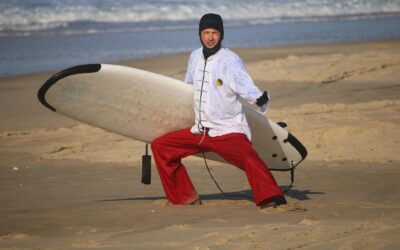
The only drawback of the retracted rear knee is that it tends to create fatigue in the medial ligaments, hence the need for a good warm-up, stretching and complementary sports activities to strengthen the muscles that ensure joint integrity: tai chi chuan, Chen style, etc., are just a few examples. Chen-style tai chi chuanstyle tai chi chuan, paying particular attention to joint amplitude and postures, helps strengthen the body and protect it from accidents.
At Ki Surf School, the bambi stance is just a sports coach’s trick to help students reproduce the basic posture of a surfer standing on his board. Incidentally, in the Landes region of France, long-haired surfers are referred to by rugby players as chevreuils.