

A description of the daggerboards and how they work, by JF Iglesias, software developer, trainer-consultant in aerodynamic hydrodynamics and inventor of the FYN dynamic surf daggerboards.
Riding the wave
Defining the role of ailerons in just a few lines is like summarizing how a joystick works in an airplane. Press the side of the aileron, it turns on that side, press the other side, it turns on the other side, press in front, it dives and accelerates, press behind, it rises and brakes...
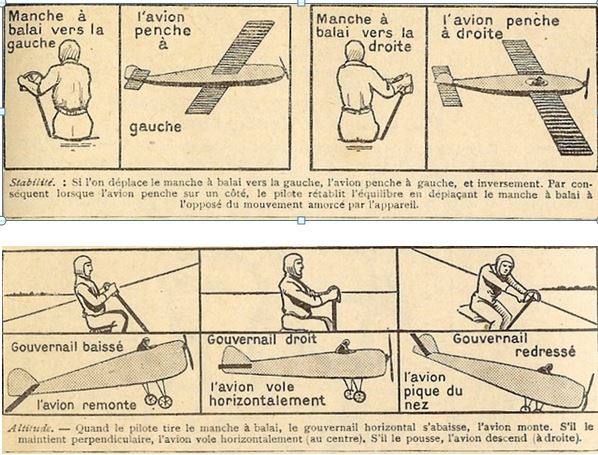
That's all there is to it, you can fly now, and enjoy your flight and surf!
What's true in one phase of flight becomes false in another, so don't try to accelerate by pushing the stick in a take-off phase, and if the rudder pedal* is not operated in harmony with the stick, it works much less well.
*Rudder bar: the horizontal bar that the pilot of an aircraft steers with his feet and which is used to turn the rudder to allow the aircraft to turn. The equivalent of a surfer's support transfers, the board itself acts as a rudder bar.
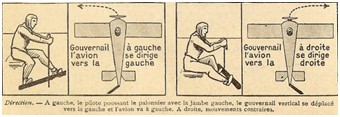
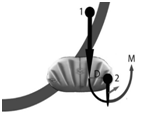
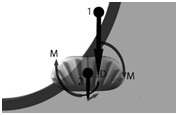
If you've noticed that image no. 2 contains an error (rudder inverted in relation to the description), then you've got the hydrodynamics prerequisites and the critical mind, bravo. We must be wary of simple descriptions that give us the impression of understanding everything and of being intelligent, even superior to ordinary mortals who are burdened with useless details. A simplistic description certainly has something to sell you, and no time to explain how it really works. In surfing as elsewhere, a simple description is unfortunately a false description. I'm going to try here to make the shortest, least false description of the surf fin possible...
The board is an extension of the surfer's body, and the fins are the fins plunged into the water that guide and propel the surfer by deflecting the flow. The role of fins is underestimated by many surfers, yet they play a crucial role in the board's maneuverability and acceleration. A fin is a wing that flies in the water. It generates lift and drag forces that affect the balance of the board. When surfers begin to feel this active fin under their board, they access a higher level of connection with the water, amplifying their intuitiveness of trajectory.
Let's get rid of a few misconceptions right away:
1. A big wave = big fins! FALSE, fin area should decrease with speed.
2. A fin close to the rail makes the board grip better! Not necessarily: the board's cant effect is greater than with a fin in the middle, so the rail grips less easily. (We'll explain this in detail later).
3. The more fins, the better! TRUE (for the salesman), FALSE for the surfer: it's the surface area in relation to the surfer's weight and maneuvering power that is essential in choosing the right fin surface. Quad configurations are reserved for very powerful and massive surfers in very hollow waves! A single fin is often more efficient than a series of fins, whose angles contradict each other in maneuvers.
4. A good fin is necessarily rigid and sharp, so a good surfer should be able to shave up close with his fins. Soft fins are reserved for beginners. FALSE! Ask cetaceans, albatrosses and Vendée Globe sailors to cross the oceans with fins, wings or sails that don't have a flexible trailing edge that follows the flow as it exits the airfoil, and they'll tell you they're not real wings! A wing must direct the flow without disturbing it!
5. The surfer is a dick, he can't read more than 264 characters without images. Well, if you're still here, dear reader, you've already exceeded the quota, so another misconception swept aside. If you're no longer here, this article is pointless, and I'd better go surfing.
Now let's take a look at the basics of fin operation in order of influence, and put an end to one last preconceived idea by stating that the most important element in surf fin operation is not the fin itself, but where you place it!
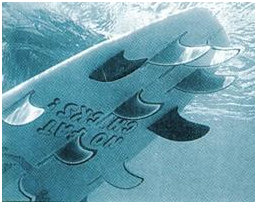
Fin layout
Influence of installation position on maneuverability
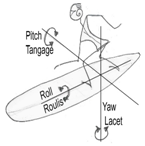
A board's maneuverability is linked to the effort required to rotate the board and its rider along a given axis. This effort varies with the distance separating the surfer's center of gravity from the board's pivot center. Maximum theoretical maneuverability is achieved when the rider's center of gravity coincides exactly with the yaw axis.
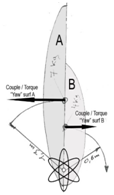
When the surfer makes a radical turn, he brings his center of gravity to the level of the global lift center of the fins, because any distance away from this point tends to increase the effort required to turn around this axis. Once the turn is complete, the pilot moves forward in search of speed.
Placing the surfer at the rear aligns the surfer's center of gravity with the board's effective pivot center, resulting from the position of the fins. Moving the fins forward reduces the fore-aft travel distance required to merge these centers, making the board easier to maneuver and relaunch.
But moving the fin too far forward degrades board stability in fast phases. Forward pressure on the submerged rail generates acceleration, but this must be compensated for by moving the fins backwards: A retracted fin pulls the rear of the board in the direction of the relative flow. The result is an automatic alignment of the board, with the front of the board facing the flow, and the stringer parallel to the direction of the relative flow. This self-stabilizing feature is called directionality*.
*Definition: directional character. Directionality stabilizes the board and compensates for front-end drag, which tends to push the nose up toward the crest. If the fin doesn't realign the rear of the board in the flow, the board goes sideways. This happens when the fin vents, stalls or breaks: the board goes into a spin, surviving.
With the fin well back and submerged, the surfer can go for a walk on the nose without changing the direction of the board. This behavior brings safety in big waves, but it's the board that's in charge - hang on and pray that the straight line is the right way!
If the center fin is placed too far forward, excessive maneuverability can lead to instability, forcing the surfer to focus on control without being able to rely on the board's directionality...
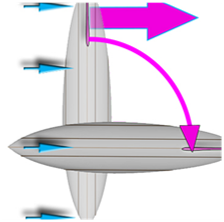
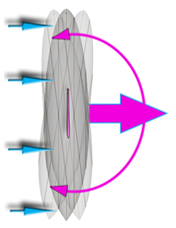
A compromise must therefore be made between manoeuvrability and stability:
:
- Fins forward = maneuverability.
- Ailerons aft = stability and directionality.
Influence of layout on fin operation
A good fin, badly placed, can become useless if it doesn't work properly. A little vocabulary clarification is in order:
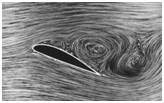
- Stall: Loss of lift resulting from too high an angle of incidence. The boundary layer lifts off the upper surface due to the excessive trajectory variation imposed by the excessive angle of incidence. Recirculation fills the lift-generating depression. The aileron brakes but no longer carries, working like a parachute rather than a wing.
- Ventilation: Suction of air from the surface to the upper surface of the aileron. When the aileron is too close to the surface, the suction on the upper surface draws in air and reduces lift. Ventilation also occurs when the roll angle is high, causing the aileron to rise to the surface. In this case, the fin loses its lift and skids, causing the surfer to fall in 90% of cases.
- Cant: A surfboard hooks the wave wall with its rail, and the fin is there to help it do so. The surfer presses on the board on the side he wants to hook, but the fin can counteract this pressing force by producing a cant in 2 ways:
- Tilt produced by the depth of the lift point: the lower the force of the fin is applied, the stronger the tipping lever, a high lift center limits the tilt. A large fin can cause the board to roll over when receiving a steep take-off and starting across the wave.
- Tilt produced by fin position: to push the rail down (moment M), the surfer's support force (1) must be applied between the center of lift of the fin and the rail, otherwise this force will be transformed into board tilt, and loss of rail grip. A surfer afflicted with this problem is obliged to "graber" to keep the rail in the water.
Various layout configurations can solve problems of stall, ventilation and cant.