In a previous article, we listed the basic rules that enable surfers to share the waves without descending into chaos or injury. So: the surfer furthest out has priority, must not start on a wave already surfed, must not tax, must not interfere with surfers further out and must be responsible for his or her gear.
Alas, the more seasoned surfer will often try to use and abuse these rules, so to speak. Like a baby who always wants the biggest slice of the cake, some surfers twist the rules of priority to their own advantage. Since common sense isn't enough, the basic rules need to be supplemented by new ones, a kind of amendment to the law.
Let's take the example of the highway code: according to the rule, the motorist entering a roundabout first has priority over the cars following him/her. This means that, when entering the roundabout, some motorists, instead of slowing down, will accelerate to force their way through. The driver who respects the speed limit, even if he was the first, will have to steer to avoid a collision. In doing so, they'll bow to those who think they're in a bigger hurry than the others, more at home, more intimidating or smarter. Those who are in a hurry, who are greedier, whether in a car or on a surfboard, will want to crush the others, sure of their right, and hiding behind a rule they've corrupted.
Being competitive, as can be seen at the world surfing championship stages, often leads to the petty use of the rule, with the aim of defeating one's opponents. Even then, the tricks of the trade, which consist in pushing the non-priority surfer to the foul, are seen by the profession as a less-than-honorable way of winning.
The competitor who commits an interference fault is stripped of the best mark in the series, and often loses his series despite his sporting prowess. Much to his frustration, he is often pushed into a foul by an ill-intentioned opponent. In this video extract, Gabriel Medina has priority. We watch as he comes up against his opponent and feigns discomfort on a low-potential wave he's caught only to provoke interference.
Let's get back to free surfing: here, the surfers are more numerous, and most of them come to relax rather than defeat an imaginary adversary, so snaking-type behavior can only lead to tension and outbursts.
First, let's classify waves into two categories: the multipic wave and the perfect wave. Their peculiarities illustrate the adjustments needed to certain rules.
1. The multipic wave
On a beach break, waves are often formed haphazardly. Waves can also vary in quality, depending on the weather.
The advantage of these conditions is that they tolerate a larger number of surfers. Scattered over a larger area, all they have to do is wait for a wave to form at their height. Unlike the perfect wave, which often has a single, precise and circumscribed take-off zone, the multi-pic spot offers a multitude of starting zones and surfing opportunities.
How annoying, then, to see surfers paddling back and forth, spasmodic, as soon as they spot a ripple, when all they need to do is wait.
Imagine two surfers, each on their own peak, a few dozen meters apart. The waves break once on the left peak, once on the right peak, with long intervals between series. Common sense would dictate that each surfer waits on his or her own peak, since the series breaks alternately on one or other peak. If the surfer on the left, at the sight of a series, rushes to the right peak to position himself in priority over the surfer who has been waiting for this series for ten minutes and steals the wave from him, two things can happen:
The second surfer, frustrated at having had the wave stolen from him, will also start sailing from one peak to the other like an annoying little hornet, and the two surfers will needlessly go to war with each other, since there were only two of them in the water!!!!
Or maybe the surfer doesn't want to be robbed of the right of way, but doesn't want to frantically swirl around his fellow surfer, who has become a rival, and will simply tax him. We call this the pedagogy of sharing.
Sometimes there are no more than six people in the water, but a single individual can upset the fragile balance at the peak.
2. The perfect wave and the rolling rule
The perfect wave is one that always rises and breaks in the same place, as is often the case with reef waves. The take-off zone is located at a precise point, sometimes very small, which means that the priority rule must be applied with care. The sandbanks of the Landes region, despite the absence of a rocky bottom, frequently offer conditions of this type. The perfect wave is an excellent illustration of the limits of basic surfing rules. And to explain the adjustments that follow.
Firstly, point A of the take-off zone is known to everyone, so it's easy to get out ahead of all the other surfers to get into a position of priority. Beyond this point, it's difficult if not impossible to get started: technically or physically, because of the presence of a cliff or rocks.
So there's nothing to stop a surfer, technically speaking, from constantly repositioning himself in a position to gain priority when he's just caught a wave. If the number of surfers at point A is too high in relation to the frequency of the waves, the other surfers won't have had time to catch their wave before the "ragasseur" has already returned to the starting position and blown away every wave in the series.
Sometimes, a small group of friends will block the peak: alternatively, they will privatize the priority zone. This will lead other surfers to want to go further inside to get priority and to start beyond the appropriate zone, which won't always get them past the first section and many waves will be wasted.
What's more, caught between two of these surfers, constantly repositioned at the peak, other users of the spot will never have the chance to take priority.
This is where an additional rule comes into play. Especially on a spot where the wave always rises in roughly the same place. A rotation must take place. The best-placed surfer, the priority surfer, doesn't go back to the peak immediately after catching a wave, but waits for the others to catch a wave before going back inside. At the very least, he waits a while before bringing up all the other surfers. He's not invisible, and nobody's fooled by his selfish game.
This means that, at the same level, any experienced surfer can look for the priority position. That's why, in competition, between surfers of excellent level, a turn-over is set up starting from the first priority position. Regardless of their position on the same wave, surfers take it in turns to take priority.
We offer Gift Vouchers that can be booked and downloaded online: give your loved ones a surfing ortai chi chuancourse or both. Can be combined with accommodation.
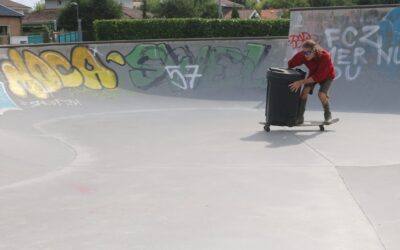
In the same way that Laird Hamilton’s experiments in Hawaii have been duplicated in Hossegor – stand-up paddle, foil, electric skates and bikes, jetski towed surfing – so too have Laird Hamilton replicas sprung up in our seaside Landes countryside. There was Fred Compagnon and his alaia-SUP, but more recently and more confidentially, there’s also Miki Dorade and his trash-can skate.