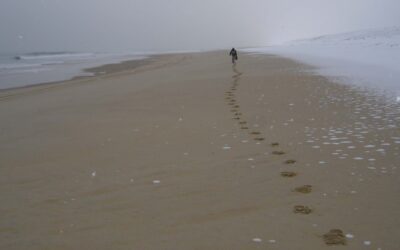

Learn to find your bearings and space out on the beach
As soon as you move away from the more concreted-in areas, the beaches of Capbreton, Hossegor and Seignosse offer vast expanses where it's good to get lost, far from the crowds, with sandbanks, dunes and forest as far as the eye can see.
However, not everyone is familiar with the beach environment, and most surfers tend to end up in the same place.
Lack of reference points
The waves break at a specific point on the beach, on a single sandbank on which there are often several surf spots. At either end of the sandbar, long waves usually break, beyond which lies the baïne, a vast expanse of deep water feared by bathers because of its currents.
When a surf instructor points out markers on the beach to help students position themselves, reach the spot and stay there, and gives them a seemingly simple instruction - such as to go straight in front of the marker - in 95% of cases, the students have already deviated from their trajectory after a few dozen meters.
Here, to the uninitiated, everything looks the same: water and sand. The eye is then drawn to what stands out in this uniform expanse, starting with the other surfers, whether they're skirting the waves in the baïne or have been swept away by the current. This is how they all end up in the same place, while the rest of the sandbar remains untouched.
A surfing lesson teaches you to decipher the variations of the ocean environment: the changing topography of sandbanks and bays, the presence of currents identifiable on the surface of the water, the color of the water as an indicator of depth, etc.
Surfing at a distance from each other
Surfers also tend to enter the water one behind the other, like ducklings in single file, which is dangerous. If the surfer in front lets go of his board or decides to catch a wave, those behind risk receiving his board and sending theirs onto the others, creating a domino effect.
When approaching the waves, surfers do their utmost to leave space between themselves and others, and try not to get in the line of other surfers, whether in front or behind them. For everyone's safety.
Homo sapiens likes to gather together, it reassures him. That's why it's still possible to surf quiet spots: you just need to observe the crowds and know how to read the ocean to identify a less crowded wave.
Let's not forget: the main danger in surfing is other surfers and the possibility of bumping into a board. But a few basic precautions are all you need to enjoy yourself in complete safety.